

The Leverage is a novel. The principal characters in the story are all fictional characters that I invented. The actions they take in the novel never actually happen in the real world. But the historical events that led them to take these actions are real. There are also many historical characters who appear or are referenced in the novel. Most of them (J. Edgar Hoover, Roy Cohn, Jeffrey Epstein, Craig Spence, and others) are dead. There are other characters who are not dead; some of those are still making new history in the timeline of the novel. One such character is Donald Trump’s self-anointed “fixer,” Michael Cohen.
In Chapter 7, Michael Cohen is used as a contra-example to demonstrate how pardons are used as a tool to ensure silence. People who did not cooperate with investigations get pardoned (Flynn, Stone, Bannon, Manafort, et al). People who did cooperate with investigations (like Cohen), were not pardoned, and in his case, went to jail. Chronologically in the story timeline, Chapter 7 takes place in May of 2025. It was written in roughly January of 2026.
In August of 2026, there appeared to be a rapprochement between Trump and Cohen. On August 20th the President appeared on Michael Cohen’s radio program on 77 WABC. “I respect the fact that you recanted everything you said.” And, “You took it back. I wouldn’t even be talking to you right now if you didn’t, to be honest.” Cohen does not correct him. He has re-submitted his pardon application to the White House.
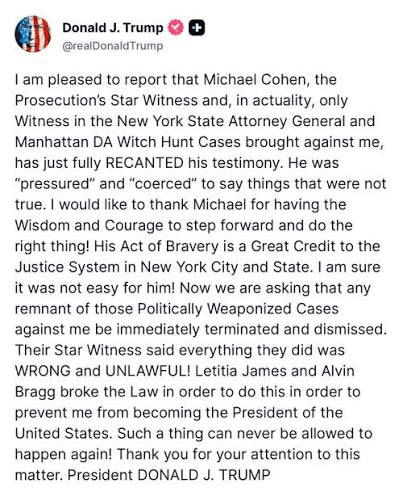
On September 4th on Truth Social, Trump posted that Cohen “has just fully RECANTED his testimony.” He demanded that the remaining cases against him “be immediately terminated and dismissed.” When asked on SiriusXM whether he has recanted, Cohen responded “No, to the exact contrary.” He felt pressured. His testimony was truthful and accurate.
This temporal collision of history, current events, the writing window, and the publishing window creates a challenge for a book like The Leverage. That challenge is exacerbated in the world of traditional publishing. If you are publishing a novel traditionally, the lag between completing a manuscript and the novel being released is a minimum of 18 months. So if I sold the publishing rights to the book right now (September of 2026), it would not be released until spring of 2028. A lot of things can change between now and then. If I publish traditionally I can’t update the manuscript to reflect that. Not to create spoilers for my own novel, but a lot happens in 2028.
On the other hand, if I publish independently, not only do I move that date in from spring of 2028 to late 2026, I also retain vastly more control to modify the manuscript up until the last moment before publication. I have the ability to control the online presence of the book in the form of The Leverage website, and in particular the Source Register (more about the Source Register here). Finally, in the case of the ebook version, it is possible that I can even update books I have already sold to better reflect evolving history.
So what does publishing independently cost me? If I publish independently, I don’t get an advance on royalties, although independently I will start earning royalties much sooner, and my share of the royalties is much higher. The other thing it costs me is that I am responsible for a lot of the blocking and tackling of publishing myself. I have to find (and pay for) my own editor. I did that; I found a fantastic one via The Independent Editors Group. I have to find and pay for a cover artist. That’s currently in process. Dozens of little administrative tasks are now my responsibility.
Then there’s distribution. Online distribution is not an issue. Online distribution for both physical and digital books has become trivial thanks to Amazon, Apple, Barnes and Noble, etc. IngramSpark makes the book available to brick and mortar retailers, libraries, and universities. This hybrid model of Kindle Direct Publishing (KDP) and IngramSpark is becoming increasingly popular.
Finally, there’s the issue of marketing. The sad reality is that even if you publish via a Big Five publishing house, unless you are a known entity or a celebrity, they are not putting real marketing oomph behind your book. A first-time author is largely responsible for their own marketing. Publishing houses are not sending unknown authors out on book tours in 2026.
In the future, I’ll do more posts about the details and mechanics of the independent publishing process, including deeper dives into the economics (which stunned me), marketing, and distribution.
And just to wrap up how I am handling the summer 2026 Cohen situation in the novel; the scene set in May of 2025 stands, but in addition, I dropped a brief mention of the summer 2026 exchange into a scene set in September of 2026.